
Caring for Tiny Teeth: A Complete Guide to Infant Oral Health
Pregnancy and childbirth can be exhausting and overwhelming experiences for parents, especially new ones. But the moment you hold your baby, its beautiful face, tiny fingers, plump feet, and little toothless smile make this journey worthwhile.
Speaking of toothless smiles, do you know a baby’s mouth is considered sterile (germ-free) at birth? While an adult’s mouth may harbor 50 to 100 billion microorganisms, a newborn’s mouth does not contain any until exposed to them via the environment or caregiver.1,3 This germ-free state may change from five minutes to a few hours after birth.1,2
Hence, infants’ oral health care and prevention should start from day 1.

Don’t worry! This article will provide all you must know about your little one’s oral health.
What New Parents Should Expect
Drooling
Drooling! Lots of drooling! Newborn babies tend to drool saliva because they cannot swallow and coordinate their muscles. Their lower jaw is more petite and positioned backward from the upper jaw, giving the mouth an open position, further increasing the drooling.
Drooling is expected up to the age of 2 years, peaking around 5 to 6 months due to teething.4 Around this time, you can expect your baby’s first milk tooth.
When to worry
It is common for babies to wet their clothes a little with drool. But if you notice a large area covered with drool, your baby could be drooling excessively, indicative of an underlying cause such as:4
- An object stuck in the food pipe
- Infections involving mouth and throat
- Stomach issues such as gastroesophageal reflux
- Diseases affecting nerves or muscles
- Exposure to drugs such as morphine, pilocarpine, or benzodiazepines
- Exposure to elements such as mercury, selenium, or organophosphate compounds
- Mental retardation
How to care
A mild degree of drooling is normal and does not need intervention. However, excessive drooling can damage the skin. It is best to consult a paediatrician for a barrier cream and check your baby’s overall health.
Meanwhile, keep the area dry by gently dabbing the corners of the mouth with a clean and soft piece of cloth. Avoid rubbing aggressively; your baby’s skin is too delicate for a rub.

(Reference: https://thespeechies.com/drooling-when-it-stops-being-cool-to-drool/)
Teething Challenges
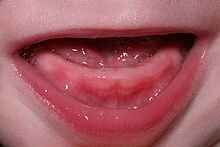
Teething is a natural process in which your baby’s mouth and gums prepare to receive its first set of teeth. These 20 milk teeth erupt over the age of 6 months to 30 months in the sequence: lower central incisor, followed by the upper central incisor, upper lateral incisor, lower lateral incisor, first primary molars, upper canine, lower canine, lower second primary molar, and upper second primary molar.
But along with those adorable tiny teeth comes a lot of discomfort, including
- Fever
- Irritation
- Drooling
- Upset stomach
- Ear rubbing/pulling
- Swollen and painful gums
- Weight loss
- Sleep disturbance
- Severe crying
You may also notice a bluish dome-shaped swelling in your baby’s gums before the tooth eruption, called an Eruption Hematoma or Eruption Cyst. They are often painless and resolve as the tooth erupts.
How to manage discomfort
If you’re an Indian, I’m sure you have heard an elderly person recommend Calcarea Phos, a homeopathic medicine, to your teething baby. However, the U.S. Food and Drug Administration warns against the use of homeopathic teething tablets and gels since they may pose risks such as difficulty breathing, muscle weakness, constipation, difficulty urinating, excessive sleepiness, and even seizures when administered to a baby.
Teething is a natural process that can be managed without drugs or medicines. Here are the other ways you can manage your baby’s discomfort due to teething:
- Gently massaging baby’s gums with a clean finger
- Providing teething toys made of firm rubber
- Cold compresses with the help of chilled teething rings
(“Remember—cool, don’t freeze!”! Frozen teething rings can become too complicated and may harm your baby’s delicate gums. For the safest soothing effect, chill the teething ring in the refrigerator for a while instead of freezing it.)
(Reference: https://en.wikipedia.org/wiki/Teething)
Precautions
- Once you notice your baby starting to mouth, that is, putting objects in its mouth, supervise it to avoid choking hazards.
- Clear the tiny objects, such as coins, buttons, and marbles, that can be choked upon from your baby’s vicinity.
- Do not hang teething rings or amber bracelets around their neck to avoid choking hazards.
- Do not cover your baby’s hands with mittens. Let them explore all they want, but ensure cleaning their hands from time to time.
Oral Hygiene for Infants
Teeth or no teeth, oral health care is essential for everyone! The American Association of Pediatric Dentistry emphasizes the importance of adopting the following measures to ensure optimal oral health for infants:7
- Parents’ oral health is key to their baby’s oral health. Research suggests that caries-causing bacteria can be transmitted from parents or primary caregivers to infants. Therefore, maintaining proper oral hygiene and dental care is not just important for your child—it’s equally crucial for you!
- Gently wiping your baby’s gums and tongue with a damp cloth helps remove any residue from breast milk or formula, reducing the risk of infections and bad breath. It also stimulates saliva production, further improving oral health. Aim to clean the tongue at least once daily, ideally after the feed. You can also use a soft-bristled baby toothbrush or a baby-safe tongue scraper. Remember to be gentle.
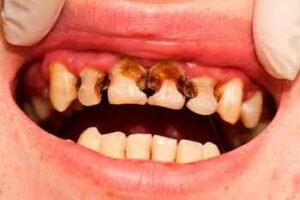
- Once your baby’s teeth begin to emerge, typically around 6 months of age, brushing with fluoridated toothpaste can help prevent early childhood caries—a type of tooth decay often seen in children who are bottle-fed before bedtime.
Consult your dentist for the right fluoride toothpaste according to the fluoridation levels in your local water supply. This ensures healthy happy teeth for your baby without worrying about fluoride toxicity.
Diet and Oral Health
Diet and oral health are directly related. Introducing healthy habits to your baby from an early age will instil the importance of oral health care and boost overall confidence in your child.
- Avoid bottle feeding at bedtime to prevent early childhood caries. As mentioned earlier, early childhood caries affects children habitual of bottle feeding before bedtime. The retention of milk in their mouth for a long period gives rise to caries-causing bacteria. It is a painful condition affecting most of the teeth.
- Instead of feeding your baby just before bedtime, try feeding them around dinnertime or at least 15-20 minutes before bedtime.
- You can gradually reduce the amount of milk in the bottle. Once they grasp and hold it, you can slowly switch to a cup instead.
(Reference:https://www.urmc.rochester.edu/news/story/leading-the-way-in-early-childhood-caries-research)
- Various studies recommend avoiding food items with added sugar in children under 2 years of age.6 This will keep your baby’s teeth and heart happy and healthy.
Other Normal Oral Conditions in Infants
Oral health in infancy is usually overlooked because most babies are born without teeth. However, you may find certain conditions in the mouth present at birth. These are:
Natal and Neonatal Teeth
Natal teeth are the teeth present at birth. Neonatal teeth erupt in the first month after birth. Although rare, they are normal occurrences. They vary in size and shape, from small and conical to resembling the size and shape of a normal tooth. Their cause remains unknown.
Complications
- Painful ulcer on the back of the tongue due to the sharp edge of the teeth (Riga-Fede disease)
- Injury to mother’s breast while breastfeeding
- Chances of swallowing loosened teeth
Treatment and Management
Visit a dentist for an X-ray. The treatment is based on the findings in the X-ray.
- If the natal or neonatal teeth are one of the 20 milk teeth, your doctor will advise retaining them.
- The upper sharp edge can be smoothened to prevent injury to the baby’s tongue and mother’s nipples.
- However, if they are not a part of the dentition, it is best to remove them.
Bumps and Ridges
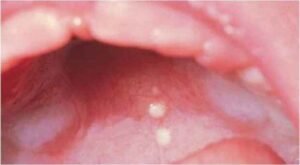
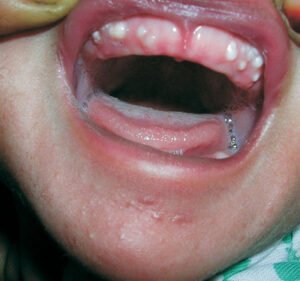
If you find little white-colored bumps or ridges in your baby’s mouth, do not worry. They are harmless.
Epstein pearls are small tissue pockets filled with keratin found in the midline of the palate. Bohn’s nodules are nodules of salivary tissue found on the gums. These lesions are painless and do not pose any problems.
Treatment
These lesions resolve on their own and disappear shortly after birth. Hence, no treatment or intervention is required.
Oral Candidiasis
Oral Candidiasis is a yeast infection (thrush) that appears as white cheese-like patches. If removed, the patches reveal a reddish, inflamed underlying surface.
Treatment
Oral candidiasis is self-limiting in nature, meaning it resolves on its own. However, anti-fungal medication, such as nystatin, can be applied topically to the baby’s mouth and the mother’s nipples.
Infant’s First Dental Visit
Timing of the First Visit
The American Academy of Paediatric Dentistry recommends that children have their first dental visit by the time their first tooth eruption occurs or by the baby’s first birthday.
This helps the child familiarize with the dental setup and build comfort, trust, and rapport with the dentist from a young age. It diminishes the fear and apprehension in the child’s mind and makes them more compliant with dental treatment in the future.
What to Expect During the Visit
The dentist will examine your child’s gums, teeth, and oral tissues. Besides dental findings, they may also look for oral manifestations of any other diseases. Certain diseases show symptoms in the oral cavity before manifesting in the body. A dentist can look out for these findings, and we can prevent the acceleration of the disease.
You will also receive advice on teething, brushing, and diet. If you have any questions, do not hesitate to ask your dentist.
(Here’s a tip: For a smooth dental visit, ensure your baby rests well the night before the visit. Try scheduling the visit in the morning when the child is fresh and energetic. This reduces the chances of them being fussy and irritated.)
Common Concerns Among New Parents
Tooth eruption delays: What is normal and when to worry
All children are different, and so are their bodies. Do not panic if your child does not have a tooth or two by 6 months. A delay in tooth eruption up to 12 months is normal if your child is healthy and fine.8
However, a further delay in tooth eruption calls for a visit to the dentist. A dental X-ray helps determine the tooth eruption stage and estimated time of emergence.
Misaligned or crowded baby teeth: Is it a concern?
The ideal set of baby teeth is well-aligned with spaces between them. These spaces help to accommodate the larger size of permanent teeth set.
Hence, misaligned or crowded baby teeth can be concerning and indicate an underlying problem. Visit your dentist for an opinion.
Baby sucking habits (thumb or pacifier): Effects on oral health and when to intervene
Thumb Sucking
Do you know babies start sucking their thumbs and fingers in the womb itself?
Thumb sucking is a primitive reflex seen in babies that is associated with self-soothe and security feelings. A primitive reflex is a natural involuntary action that helps the baby to survive. Thumb sucking is expected up to 5 years of age. It usually ceases on its own between the ages of 2 and 4.
But beyond the age of 5, thumb sucking can be harmful to oral health. The pressure applied by the thumb alongside the tongue poses a risk of developing malocclusion, typically an open bite.
Pacifier use
As the name suggests, a pacifier is used to pacify a crying or fussy baby. Using a pacifier is acceptable until your baby’s teeth emerge, after which efforts should be made to cease the habit.
Like thumb sucking, prolonged use of the pacifier can also lead to an open bite.
Management
- Encourage your child to break sucking habits by offering praise.
- Explain the harmful effects of sucking a thumb or pacifier to them.
- Reward their progress as they work toward breaking the habit.
- Consult a dentist about orthodontic appliances such as a thumb crib, rake, or bluegrass appliance.
Summary
Oral health is an essential part of overall health. Early oral health care introduced to children as young as a few months old has proven to prevent future dental and gum problems.
As parents, we have a thousand worries in our minds. But rest assured that drooling, teething, thumb, and pacifier sucking are various normal conditions seen in infants. Other typical findings include Natal and neonatal teeth, Epstein pearls, Bohn’s nodules, oral candidiasis, and many more.
The best way to ensure optimal oral health hygiene in your child is by starting early–gently wiping your baby’s tongue and gums with a damp cloth after feeding them or brushing and flossing their teeth twice daily with fluoridated toothpaste. Oral health checkups at regular intervals allow for the early detection, diagnosis, and correction of malocclusion, malalignment, and other jaw problems.
References
1.Sampaio-Maia B, Monteiro-Silva F. Acquisition and maturation of oral microbiome throughout childhood: An update. Dent Res J (Isfahan) [Internet]. 2014 [cited 2025 Jan 22];11(3):291–301. Available from: https://www.ncbi.nlm.nih.gov/pmc/articles/PMC4119360/
- Nelson-Filho P, Borba IG, Mesquita KSF de, Silva RAB, Queiroz AM de, Silva LAB. Dynamics of microbial colonization of the oral cavity in newborns. Braz Dent J [Internet]. 2013 Aug [cited 2025 Jan 22];24:415–9. Available from: https://www.scielo.br/j/bdj/a/w8bKYwxMCrbcP3mSyrJ8WMy/
- Krishnan K, Chen T, Paster B. A practical guide to the oral microbiome and its relation to health and disease. Oral Dis [Internet]. 2017 Apr [cited 2025 Jan 22];23(3):276–86. Available from: https://www.ncbi.nlm.nih.gov/pmc/articles/PMC5122475/
- Leung AK, Kao CP. Drooling in children. Paediatr Child Health [Internet]. 1999 Sep [cited 2025 Jan 25];4(6):406–11. Available from: https://www.ncbi.nlm.nih.gov/pmc/articles/PMC2827743/
- Wuni A, Iddrisu M, Angliengmene AA, Salia SM, Chanayireh L, Mohammed IS, et al. Knowledge and management practices of infant teething symptoms among mothers in a tertiary facility in Ghana. Pan Afr Med J [Internet]. 2024 Feb 13 [cited 2025 Jan 25];47:65. Available from: https://www.ncbi.nlm.nih.gov/pmc/articles/PMC11055185/
- Vos MB, Kaar JL, Welsh JA, Van Horn LV, Feig DI, Anderson CAM, et al. Added sugars and cardiovascular disease risk in children: a scientific statement from the american heart association. Circulation [Internet]. 2017 May 9 [cited 2025 Jan 28];135(19). Available from: https://www.ahajournals.org/doi/10.1161/CIR.0000000000000439
- Perinatal and Infant Oral Health Care. The Reference Manual of Pediatric Dentistry Chicago, Ill: American Academy of Pediatric Dentistry; [Internet]. 2024:318-22. Available from: https://www.aapd.org/media/policies_guidelines/bp_perinataloralhealthcare.pdf
- Holt R, Roberts G, Scully C. Oral health and disease. West J Med [Internet]. 2001 Mar [cited 2025 Jan 28];174(3):199–202. Available from: https://www.ncbi.nlm.nih.gov/pmc/articles/PMC1071315/
Image Courtesy
The post uses all third-party images to make it reader-friendly. The author never claims ownership of any of them. Image courtesy is given to every image used in the story. Prime Avenue, a professional content writing agency, is dedicated to providing readers with the latest updates and information through quality content.
About the Author
Dr Sobia Siddiquie is a passionate Dentist by profession, but she also likes writing. She specializes in medical writing and uses her extensive knowledge and experience in the medical and healthcare domain to help readers learn more about and improve oral health.
She also writes in the lifestyle segment. You can learn more about her work on her LinkedIn profile, https://www.linkedin.com/in/dr-sobia-siddiquie-749586286/.
You can connect with her at theprimeavenue@gmail.com