
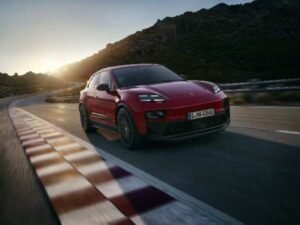
Porsche’s once-relentless push toward full electrification has lost traction. What began as a bold march into an all-electric future has now evolved into a strategic reset — one that prioritises profitability, engineering excellence, and market realism over corporate zeal.
The first signs of trouble appeared in mid-2024, when CEO Oliver Blume admitted that “luxury EV demand is maturing slower than expected.” By early 2025, Porsche was compelled to acknowledge that its electrification roadmap had become financially unsustainable, resulting in a €800 million burden on profits. Then came the September 2025 restructuring — a sweeping overhaul that delayed its next-generation EV platform to the early 2030s and scrapped the Cellforce Group battery cell venture due to poor economies of scale.
The fallout is painful. Porsche has booked €3.1 billion in extraordinary expenses for 2025, dragging operating margins down to a fragile 2%, far below its traditional double-digit comfort zone. Technically, its advanced 800V battery architecture — the pride of the Taycan and Macan EV — delivers world-class performance, but at high cost and low scalability. Combined with weak luxury EV demand in China, tariff barriers in the U.S., and waning European enthusiasm, Porsche’s BEV share has stalled at around 20–22% of total sales.
The company’s new playbook focuses on resilience. Porsche will extend the life of its ICE and hybrid models into the 2030s, with the next-generation large SUV now slated to launch as a hybrid rather than a full EV. Battery sourcing will pivot to partnerships instead of in-house manufacturing, improving cost flexibility. Crucially, Porsche’s future product strategy will be modular, enabling a variable powertrain mix that can adapt to shifting consumer demand. The aim: rebuild profitability to 10–15% by 2027 without compromising on brand DNA.
This recalibration is not unique. Mercedes-Benz has softened its 2030 all-EV stance, Audi has delayed several EV launches, and Toyota’s long-championed hybrid pathway suddenly seems prescient.
Against this backdrop, Jaguar Land Rover’s (JLR) pledge to go 100% electric by 2030 looks audacious — perhaps even precarious. While Jaguar’s pivot aligns with emission norms, it risks overexposure to volatile lithium supply, battery inflation, and infrastructure gaps. Hybrids and ICE models still offer profitability bridges that JLR is now foregoing — a luxury Porsche refuses to gamble on.
In essence, Porsche’s “return to basics” is less a retreat and more a recalibration. The Stuttgart marque is proving that the race toward electrification is not a sprint but an endurance test — and those who pace themselves may ultimately lead the pack.
About the Author – CHANDAN BASU MALLIK
British Indian motoring journalist, seasoned automotive aficionado, marketing writer, blogger, and solopreneur specialising in copy and content writing. With over three decades of global automotive experience, I write on multiple domains in most digital content formats (long and short)
https://www.linkedin.com/in/chandan-basu-mallik-314612321//
@Theprimeavenue
You can connect with me on my email id chandan.theprimeavenue@gmail.com
Image Courtesy
The post uses all images to make it reader-friendly. These are all third-party images; the author does not claim ownership. Prime Avenue, a professional content writing agency, is committed to delivering readers the latest updates and information through high-quality content.
You can read more about Auto World @ https://theprimeavenues.com/the-truth-about-should-i-lease-or-finance-my-used-car-in-2-minutes/
#Porsche #EVStrategy #AutomotiveIndustry #ElectricVehicles #AutoBusiness #Sustainability #LuxuryCars #HybridTechnology #JLR #MercedesBenz #Toyota #Audi #MobilityShift #AutomotiveInnovation #AutoInsights #CarIndustryTrends