Executive Summary
Product returns are one of the most persistent and costly challenges facing e-commerce retailers worldwide. According to the National Retail Federation, return rates for online purchases consistently run two to three times higher than those seen in physical retail, placing significant pressure on reverse logistics, inventory management, and overall profitability.
This case study examines how a growing UK-based eCommerce retailer, operating across multiple product categories, identified and addressed the root causes of avoidable returns. By investing in stronger product content, clearer customer guidance, and a structured programme of return data analysis, the retailer achieved a measurable reduction in return volumes, lower operational costs, and improved customer satisfaction scores.
The approach drew on widely recognised best practices in customer decision-making and information architecture, and applies to any e-commerce business seeking to reduce the cost of returns without compromising the customer experience.
Note on commercial confidentiality: Specific performance figures have been withheld at the client's request to preserve commercial confidentiality. The outcomes described in the Results section reflect verified internal findings from the retailer's own measurement programme.
To understand the significance of this work, it helps first to appreciate the scale of the problem the retailer was facing.
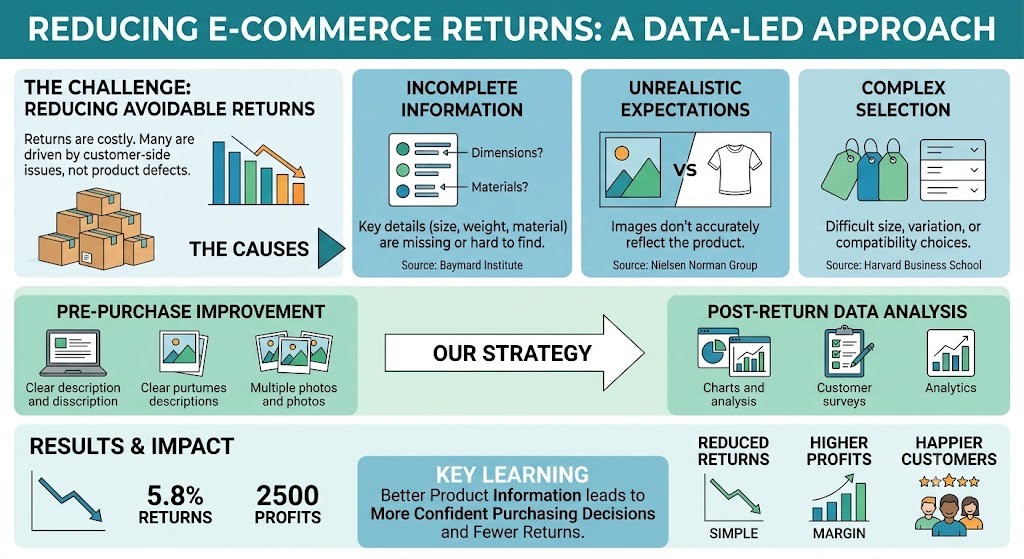 Avoidable returns in eCommerce — the link between pre-purchase information and post-purchase outcomes
The Challenge: A Growing Business with a Growing Returns Problem
The retailer operated a growing online business with a diverse product catalogue spanning homewares, accessories, and lifestyle goods. As the customer base expanded and order volumes increased, so did the volume and cost of product returns.
While a proportion of returns is inevitable in any online retail environment, internal analysis revealed that a significant share of returns was avoidable. These returns were driven not by product defects or genuine dissatisfaction, but by customers receiving something that did not match what they expected or needed when they placed the order.
The consequences extended well beyond the cost of refunds. Each return triggered a chain of operational activity: product inspection, condition grading, inventory updates, restocking decisions, and, in many cases, write-downs on products that could not be resold at full price. The Chartered Institute of Procurement and Supply estimates that the true cost of a return, when all handling and administration is included, can reach two to three times the original outbound fulfilment cost.
Customer service teams were also absorbing the impact, spending a disproportionate amount of their time handling return-related queries, chasing refunds, and managing customer dissatisfaction that could have been avoided.
The retailer recognised that the problem was not primarily a fulfilment or logistics issue. It was a pre-purchase information problem. Customers were making purchasing decisions without the full picture, and the business was bearing the cost.
With the scale and nature of the challenge established, the next step was a structured investigation into what was actually driving avoidable returns across the product catalogue.
Understanding the Causes: What the Data Revealed
The retailer undertook a thorough review of return data, customer feedback, and product page performance before designing any response. This diagnostic phase drew on principles from root cause analysis, a standard approach in operational improvement that focuses on identifying underlying causes rather than treating symptoms. Three recurring themes emerged.
1. Product Information Gaps
A consistent finding across multiple product categories was that product pages lacked the level of detail customers required to make confident purchasing decisions. Key attributes such as dimensions, materials, weight, compatibility requirements, and intended use were either absent, buried within dense descriptions, or presented inconsistently across the catalogue.
Research from the Baymard Institute, one of the leading independent authorities on eCommerce usability, consistently identifies incomplete product information as one of the primary drivers of both cart abandonment and post-purchase returns. Customers who cannot find the information they need before purchase will either abandon the transaction or, if they proceed, face a higher likelihood of disappointment upon delivery.
2. Product Expectation Mismatches
The second theme related to the gap between what customers anticipated and what they received. Customer feedback revealed that product images were often limited to a single angle, failed to convey accurate scale, or did not reflect real-world colour and finish under normal lighting conditions.
The Nielsen Norman Group, a globally respected user experience research organisation, has documented extensively how product photography directly influences purchase confidence and post-purchase satisfaction. Where visuals are inadequate or misleading, the mental model a customer builds before purchase diverges from the product reality, and returns are the predictable result.
3. Sizing and Selection Difficulties
Several product categories required customers to make decisions based on measurements, technical specifications, or product variations such as size, finish, or compatibility. Without sufficient decision-support content, customers frequently selected options that were not the best match for their requirements.
This is a well-documented pattern in e-commerce. Harvard Business School research has noted that when customers face complex choices without adequate guidance, the quality of their decisions deteriorates, and dissatisfaction rises. Clear comparison tools, sizing guidance, and compatibility information are not supplementary niceties; they are functional necessities for high-consideration purchases.
Having identified the core drivers of avoidable returns, the retailer was in a strong position to set clear objectives and design a practical, structured response.
Objectives
The retailer established five clear objectives for the improvement programme:
- Reduce avoidable product returns across priority product categories by addressing pre-purchase information gaps
- Improve customer purchase confidence so that buyers can make informed decisions with greater certainty
- Strengthen the quality and consistency of product content across the catalogue
- Improve operational efficiency by reducing the volume of return-related processing and customer service activity
- Increase profitability by lowering the direct and indirect costs associated with avoidable returns
The Strategy: Fixing the Problem Before the Purchase
The retailer's strategy was grounded in a straightforward principle: the best way to reduce returns is to help customers make better decisions before they buy. This reflects a broader shift in eCommerce thinking, documented by organisations such as the World Retail Congress and IMRG, towards pre-purchase experience as the primary lever for return reduction.
Strengthening Product Information
Product descriptions were audited and rewritten across priority categories. The objective was to ensure that every product page answered the questions a customer would reasonably ask before committing to a purchase. This included precise dimensions, materials and finishes, weight, compatibility notes where relevant, and clear descriptions of intended use and product limitations.
Content was reorganised using principles from progressive disclosure, presenting the most decision-critical information prominently and allowing customers to access additional detail without cognitive overload. This approach, well established in UX research, reduces the effort required to reach a confident purchase decision.
Improving Product Visualisation
Product photography was enhanced to provide a more complete and accurate representation of each product. Key improvements included multiple viewing angles, lifestyle context images to convey scale and real-world appearance, close-up detail shots for texture and finish, and consistent lighting and background standards across the catalogue.
The goal was to close the gap between customer expectations and product reality. As Shopify's commerce research and independent studies consistently show, high-quality, multi-angle product imagery is one of the most effective single interventions for reducing return rates in online retail.
Enhancing Sizing and Selection Guidance
For product categories where customers regularly struggled with selection decisions, the retailer introduced structured decision-support content. This included:
- Detailed sizing guides with measurement references and worked examples
- Side-by-side product comparison tables for variant-heavy ranges
- Compatibility checkers and specification matching guidance
- Practical "how to choose" content integrated directly into product pages
This type of content addresses what behavioural economists describe as choice overload: the tendency for complex decisions made without adequate information to produce suboptimal outcomes and subsequent regret. Structured guidance reduces uncertainty and supports better purchase accuracy.
Using Return Data for Continuous Improvement
The retailer introduced a formalised return data review process, analysing return reasons, product-level return rates, and customer feedback on a regular cycle. This created a feedback loop that allowed the team to identify emerging issues, monitor the impact of content improvements, and prioritise future interventions.
This approach reflects best practices in continuous improvement methodologies, including Plan-Do-Check-Act (PDCA), which is widely applied in retail operations to drive incremental and sustained performance gains.
The strategy was implemented in stages, with priority given to the highest-return product categories. The outcomes across each objective were tracked and measured consistently.
Results: Measurable Improvement Across All Objectives
Reduction in Avoidable Return Rates
Following the implementation of improved product information and enhanced visual content, avoidable return rates fell materially across the priority product categories. Products with the most significant information gaps before the programme saw the sharpest reductions. The data confirmed that customers who had access to complete, well-presented product information before purchase were substantially less likely to return the item.
Improved Customer Purchase Confidence
Customer satisfaction scores and post-purchase survey responses reflected a marked improvement in purchase confidence. Customers reported feeling better informed at the point of decision and more satisfied that the product they received matched what they had expected.
This aligns with findings from PwC's Global Consumer Insights Survey, which consistently identifies accurate and transparent product information as a leading driver of eCommerce customer trust and satisfaction.
Greater Operational Efficiency
Lower return volumes reduced the operational burden significantly. Time spent on product inspection, condition assessment, inventory updates, and return processing decreased in proportion to the reduction in return volumes. Customer service teams reported a measurable reduction in return-related contact, allowing them to focus on higher-value customer interactions.
Improved Profitability
The combined effect of lower return volumes, reduced reverse logistics costs, and lower customer service overhead contributed to a meaningful improvement in the retailer's gross margin. The investment in product content improvements delivered a return that was both measurable and sustained, validating the approach taken.
The results confirm a clear lesson that is supported by research and applicable to any e-commerce business, regardless of sector or scale.
Returns Are a Pre-Purchase Problem
Product returns are often treated as a logistics or fulfilment challenge, something to be managed efficiently after the fact. This case study demonstrates that the more productive approach is to treat returns as a pre-purchase information and guidance challenge, and to invest accordingly.
When customers have access to accurate, complete, and well-presented product information before they buy, they make better decisions. Better decisions mean fewer surprises upon delivery, fewer returns, and better outcomes for both the customer and the retailer.
The quality of a decision is proportional to the quality of information available
The retailer's experience reinforces a principle that is well established in e-commerce best practice literature: the quality of a customer's purchasing decision is directly proportional to the quality of information available to them at the point of choice. Investing in that information is not a marketing exercise — it is an operational and financial strategy with a demonstrable return. For eCommerce businesses looking to address return rates, the starting point is not the returns portal or the reverse logistics network. It is the product page.